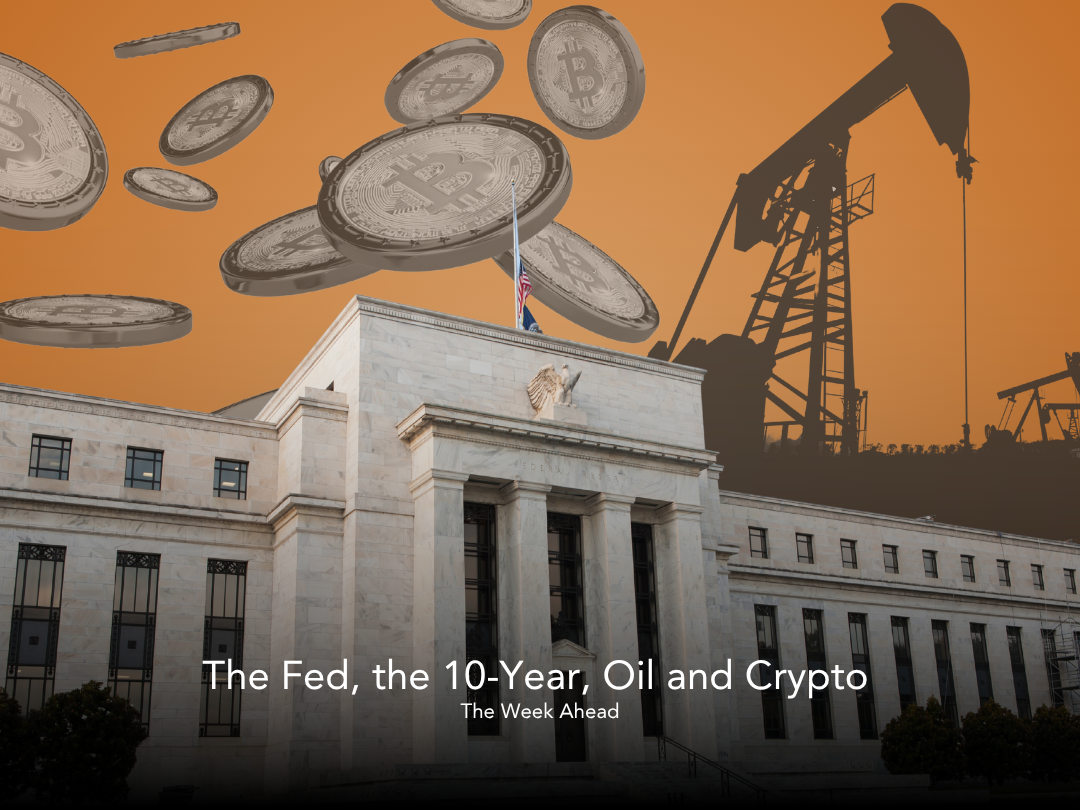
Most weeks give us one or two major stories that could move the markets. This week, we have several happening at the same time: a highly anticipated Federal Reserve meeting, an important crypto regulation vote in the Senate, oil prices remaining elevated, and the 10-year Treasury yield pushing toward 5%.
Whether you're invested in stocks, real estate, crypto, or a combination of all three, there could be plenty of movement in both directions depending on how these stories develop.
The Fed meets Tuesday and Wednesday.
The Federal Open Market Committee meets Tuesday and Wednesday, with the rate decision coming Wednesday afternoon followed by the Fed chair's press conference.
This is anything but a routine meeting.
The Fed has held its target rate steady so far in 2026, but stronger employment data and upward revisions to previous payroll numbers have changed the conversation. What looked like a fairly straightforward decision only a few weeks ago has become much more uncertain.
Inflation isn't making the decision any easier. The Fed's preferred inflation measurements continue to run above its 2% target, and higher energy prices create another potential inflationary headwind.
That leaves the Fed balancing two competing risks: keeping rates too high for too long and slowing the economy unnecessarily, or allowing inflation to regain momentum by being too accommodative.
For investors, Wednesday's headline decision matters, but we think the bigger story will be what comes afterward. Listen closely to the Fed's language and watch how the bond market reacts. A more hawkish message could push Treasury yields and borrowing costs higher, while a more dovish tone could give both stocks and bonds some relief.
The 10-year Treasury is the number to watch.
For real estate investors, this may actually be more important than the Fed's decision itself.
The 10-year Treasury yield has moved sharply higher and is approaching the 5% level. That's important because mortgage rates tend to follow movements in longer-term Treasury yields much more closely than they follow the Fed funds rate directly. We've already seen mortgage rates move higher alongside Treasury yields.
If the 10-year continues pushing above 5%, financing will become even more challenging. That means higher monthly payments, tighter cash flow on investment properties, pressure on cap rates, and fewer buyers who can qualify for homes at today's prices.
On the other hand, if the Fed's message calms the bond market and the 10-year begins moving back down, we could see some relief in mortgage rates heading into the fall.
This is why we'll be watching the bond market immediately following Wednesday's announcement. Sometimes the reaction in Treasury yields tells us much more about where markets are headed than the Fed announcement itself.
The same thing applies to stocks. When investors can earn close to 5% on Treasuries with significantly less risk, it raises the hurdle for stocks, particularly expensive growth and technology companies trading at high valuations.
The crypto vote in the Senate.
Another story we're watching closely is the CLARITY Act and the broader effort to establish a regulatory framework for digital assets.
The Senate is expected to take up an important procedural vote that could determine whether crypto market-structure legislation continues moving forward. The goal of the legislation is to provide clearer rules around digital assets and define the roles of agencies such as the SEC and CFTC.
This matters because one of the biggest issues hanging over the crypto industry has been regulatory uncertainty.
A successful procedural vote would not mean the bill automatically becomes law. There would still be several steps remaining before final passage. But it could keep the legislation alive and moving forward. If the vote fails, comprehensive crypto legislation could potentially be pushed until after the midterm elections.
Either outcome could create volatility across crypto, exchanges, custody companies, and publicly traded companies with significant digital-asset exposure.
The important thing here is not to confuse one procedural vote with final passage. Washington still has a long road to travel before any major crypto legislation becomes law.
Why oil is really an interest-rate story.
Crude oil is another piece of this puzzle that shouldn't be ignored.
Oil prices have risen dramatically from their previous lows, driven heavily by geopolitical uncertainty, sanctions, supply concerns, and continued tension in the Middle East.
Energy companies have benefited, but higher oil prices are a double-edged sword for the rest of the economy. Higher fuel costs act almost like a tax on consumers. They also increase expenses for transportation companies, airlines, manufacturers, construction companies, and businesses that rely heavily on shipping and logistics.
For real estate investors, those costs eventually work their way into construction materials, asphalt, transportation, heavy equipment, maintenance, and renovation costs. They can also put additional pressure on tenants who are already dealing with higher housing and everyday living expenses.
Most importantly, sustained higher energy prices make the Fed's inflation battle more difficult. That's why oil isn't just an energy story. It's also an interest-rate story.
What this means for underwriting.
When you put these pieces together, the 10-year Treasury remains the number we're watching most closely.
If yields continue higher, mortgage rates will likely remain elevated regardless of what the Fed does this week. That means investors need to remain disciplined when underwriting deals. A property that worked at a 6% mortgage rate may look very different at 7%. Cash flow, debt-service coverage, cap rates, and your required return all become increasingly important.
At the same time, higher rates can create opportunities. Sellers who need to move become more motivated. Builders increase incentives. Competition between buyers decreases. And investors with cash or strong financing positions gain negotiating leverage.
That's why we continue to say: there is always opportunity in the deal. The market doesn't necessarily need to be great. The numbers on the individual property need to make sense.
Locally, the Treasure Valley keeps settling.
The Treasure Valley continues to settle into a much more balanced environment compared with what we experienced during the frenzy of the last several years.
Ada County has seen some softness in pricing, while Canyon County continues to provide a more affordable entry point for many buyers. Nampa and Caldwell remain attractive alternatives for buyers who are being priced out of Boise and Meridian.
Well-priced and well-prepared homes, particularly in the more affordable price ranges, can still move quickly. But buyers have more choices today, which means sellers can no longer simply put a home on the market at any price and expect multiple offers.
For investors, we like this environment much more than the bidding-war market. You have time to analyze the numbers, negotiate repairs or concessions, compare financing options, and walk away when a deal doesn't make sense.
With financing costs likely to remain elevated in the near term, we expect this active but no longer frenzied environment to continue into the fall.
What to watch, and what not to overreact to.
There are a lot of moving pieces, but they all connect.
Watch the Fed on Wednesday, but pay even closer attention to what the 10-year Treasury does afterward. Keep an eye on oil, because sustained higher energy prices could keep inflation elevated. And don't overreact to a single procedural vote on crypto legislation. It's an important step, but there is still a long process ahead.
Most importantly, stay disciplined.
Markets like this can feel uncertain, but uncertainty can also create some of the best opportunities for patient investors. Don't buy simply because you think prices are going higher, and don't sit on the sidelines simply because the headlines sound scary.
Find investments where the numbers work today, understand your downside risk, and let the long-term fundamentals do the heavy lifting.