

Last week gave investors plenty to think about. Democrats will control both the House and Senate starting in January, tech stocks sold off sharply, the jobs report came in stronger than expected, and mortgage rates kept falling. The big question is whether this is a real shift in financial conditions or just another round of volatility.
Here's what we're watching this week.
The Midterms Are Over: What Now?
Democrats won control of both chambers on November 3, so President Trump will face a Democratic Congress beginning in January 2027. Democrats will have more say over spending, oversight, and confirmations, but the president keeps his veto, so major tax or regulatory changes aren't automatic.
Historically, stocks have often done well in the 12 months after a midterm, regardless of who wins, though that's based on a small number of elections. In the end, earnings matter more than who controls Congress.
For housing, we don't think the election alone changes the direction of the market. Borrowing costs remain the bigger factor.
We're watching which policies actually move forward and how the bond market responds, not the headlines.
A Tough Week for Wall Street, Especially Tech
Tech stocks took the brunt of last week's selling as investors questioned whether massive AI spending will pay off. Friday's partial rebound didn't erase the losses.
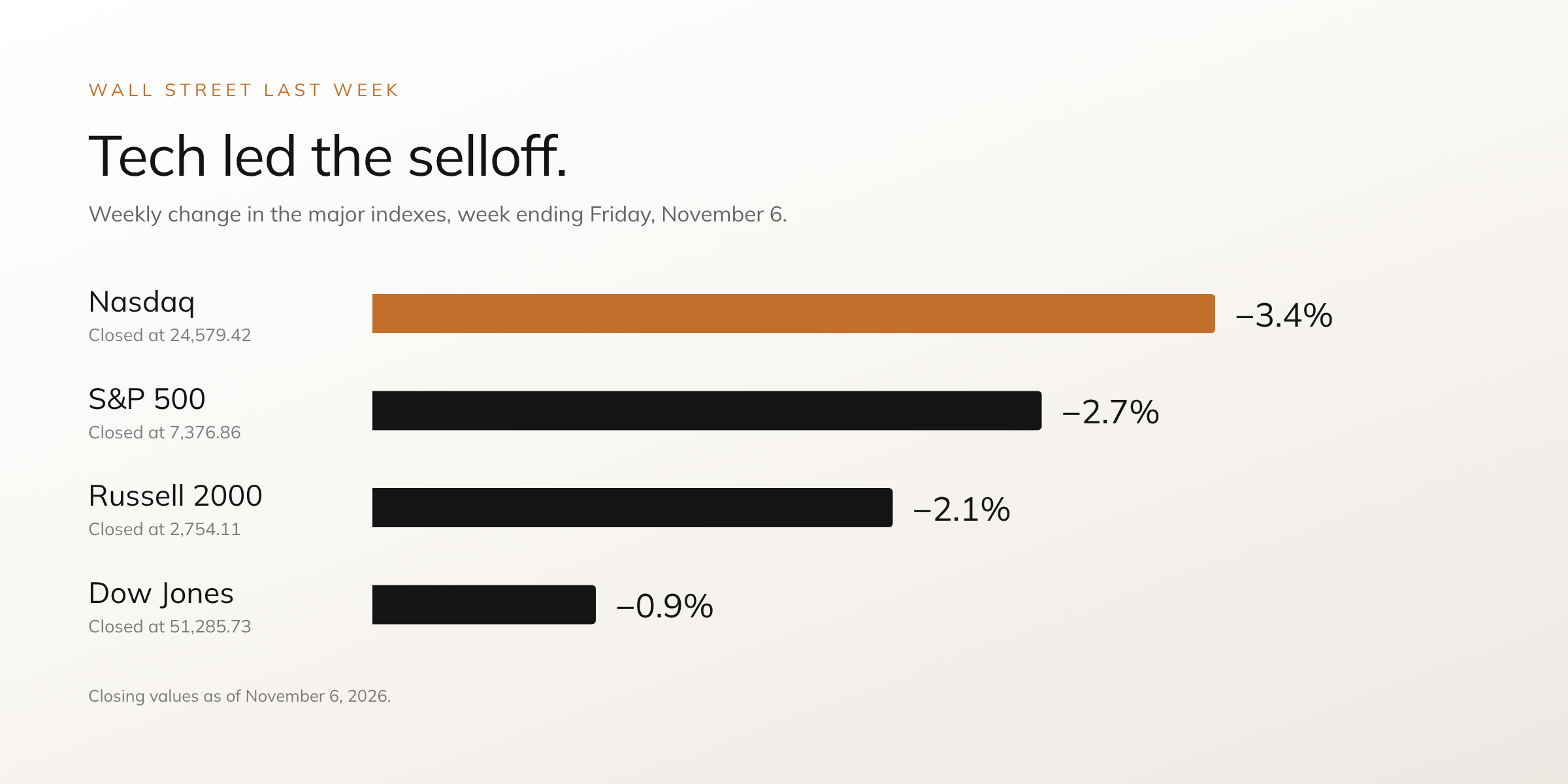
Because tech makes up such a large share of the major indexes, its declines pull down the broader market. But a tech selloff isn't the same as a recession. It may simply reflect investors resetting valuations and growth expectations. We'll be watching whether the weakness spreads into financials, industrials, and small businesses.
Now is a good time to focus on earnings, debt, and cash flow rather than assuming past winners will keep winning.
A Strong Economy Complicates the Fed's Job
The economy added 165,000 jobs in October, unemployment held near 4.1%, and August and September were revised up by a combined 84,000 jobs. Third-quarter growth came in at a 3.4% annualized rate, up from 2.2% in the second quarter.
That's good news, but it makes rate cuts less likely while inflation stays elevated. The Fed held rates at 3.75%–4.00% on October 28, and two members actually wanted a quarter-point increase.
Strong economic reports won't automatically mean higher stock prices or lower mortgage rates. This week's inflation report matters.
Mortgage Rates Are Moving Lower Again
The average 30-year fixed rate fell to 7.18% on November 5, down from 7.24% the prior week and its third straight weekly decline. The 15-year dropped to 6.57%. Rates are still well above the 6.22% average of a year ago. The 10-year Treasury yield also eased, from about 4.93% to 4.86%.
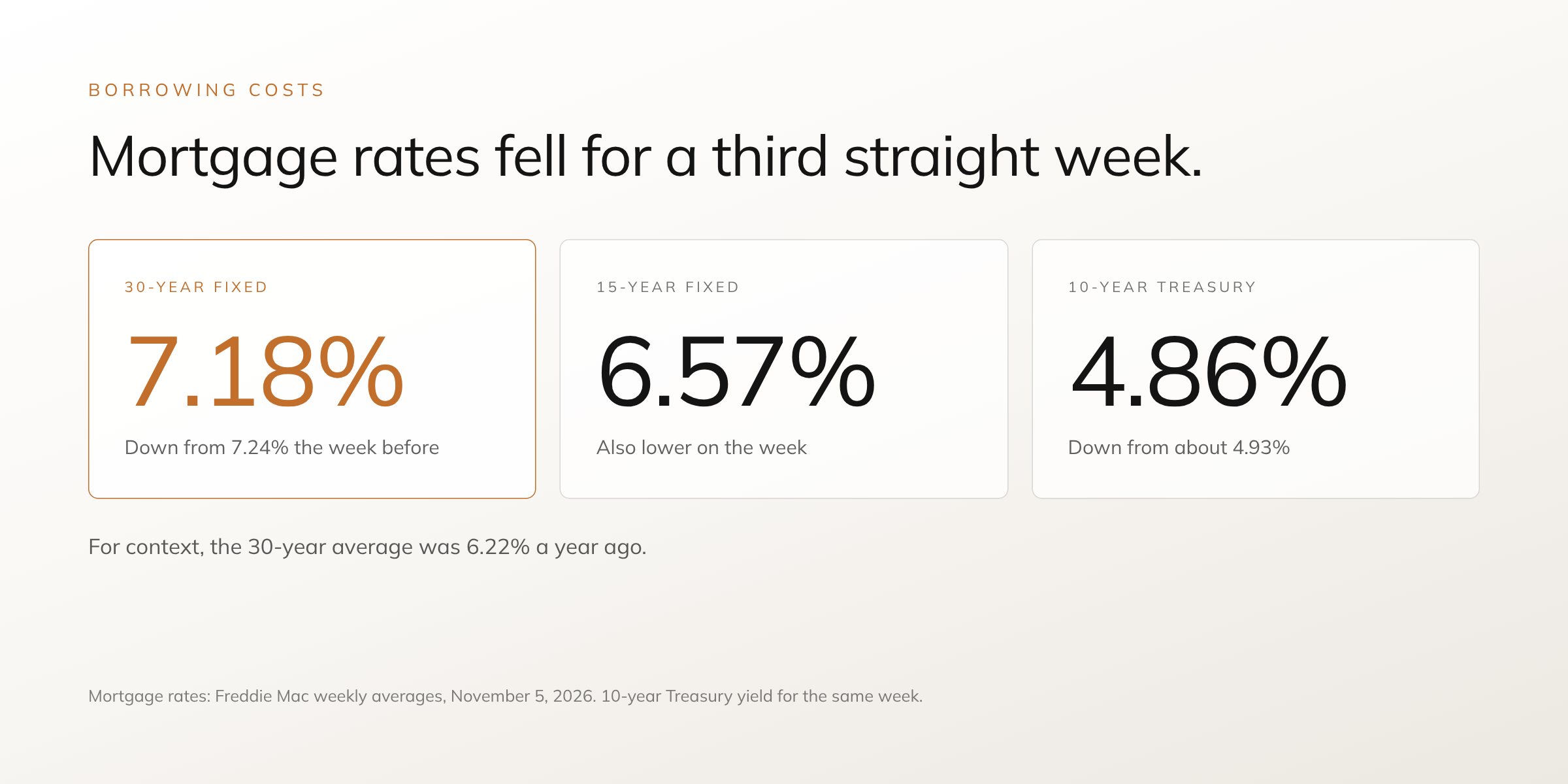
Even small rate improvements help buying power, but rates are still high relative to the rent many properties bring in. That's why negotiating financing (seller-paid closing costs, rate buydowns, builder incentives) matters as much as negotiating price. A lower payment only helps if the property still works after all expenses.
We're encouraged, but we want to see several more weeks of improvement before calling it a trend.
Treasure Valley: Buyers May Have More Negotiating Room Than They Think
September numbers for Ada County single-family homes:
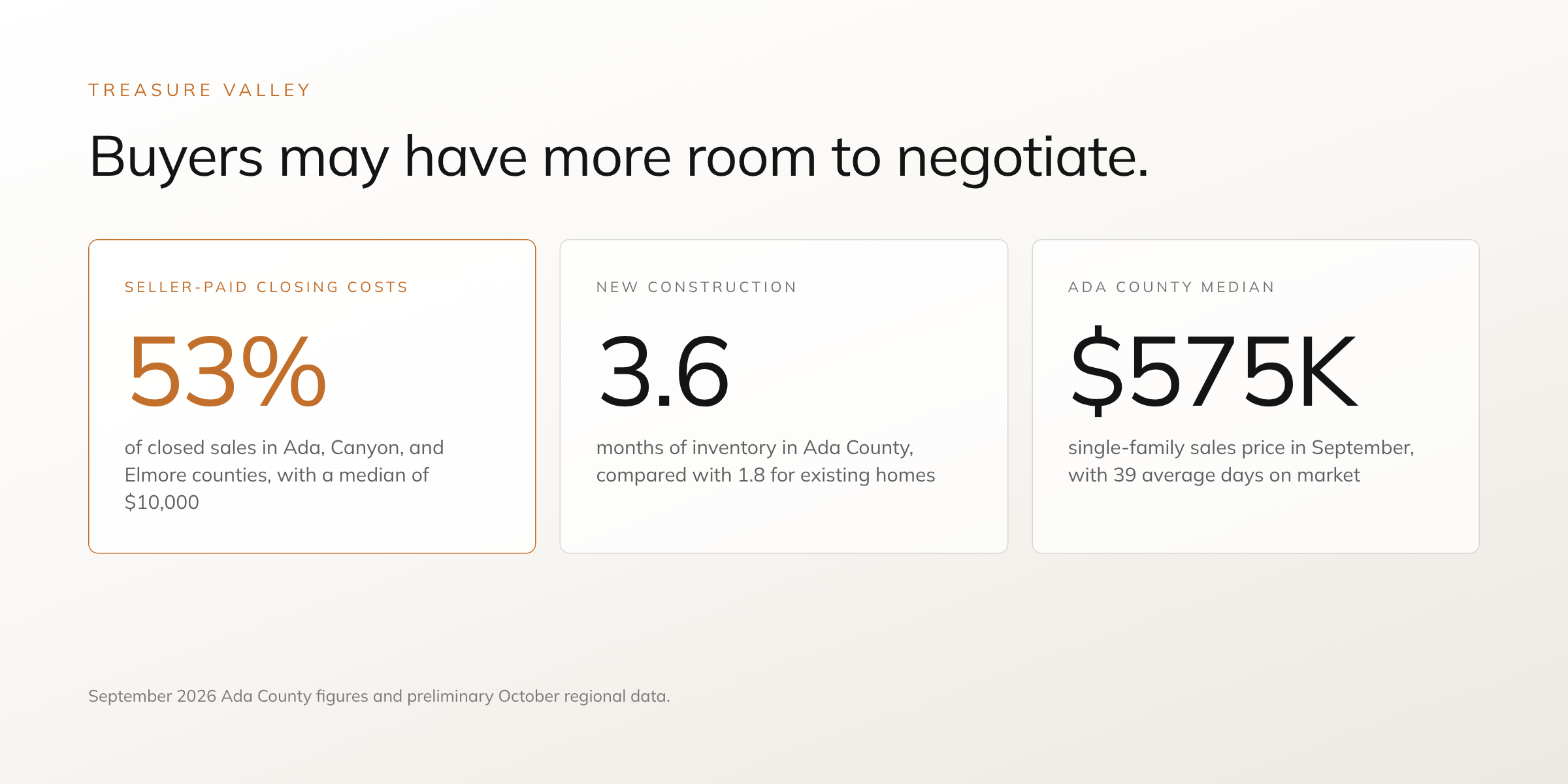
Ada County prices were still 2.9% above last year, though down from August. Canyon County's median was about $443,500, with 419 closed sales.
Preliminary October data showed medians around $550,000 in Ada and $431,900 in Canyon. Those numbers are measured differently, so we wouldn't read them as a precise monthly drop. What stood out: 53% of closed sales across Ada, Canyon, and Elmore counties included seller-paid closing costs, with a median of $10,000. The advertised price isn't always the real cost.
New construction deserves a look. Ada County had about 3.6 months of new-build inventory versus 1.8 months for existing homes, and builders carrying that inventory are often willing to negotiate. Just don't let incentives distract from the fundamentals: rent still needs to cover the mortgage, taxes, insurance, maintenance, vacancy, and management.
We still see opportunities in Boise, Meridian, Star, Kuna, Nampa, and Caldwell, but every neighborhood is moving differently.
Japan: A Risk Worth Watching
On October 30, the Bank of Japan held its rate at 1.25%, with one member pushing for 1.50%, and signaled more increases may come. Japan's 10-year bond yield sits near 2.70%.
For years, investors borrowed cheaply in yen to invest elsewhere (the "yen carry trade"). As Japanese rates rise, those positions get more expensive, and a fast unwind could force selling across global markets. That's a risk, not a certainty. We'd need to see sharp currency moves or forced selling before calling it a problem. Japan's effect on U.S. rates could go either way.
We're watching closely heading into the Bank of Japan's December meeting.
Oil Prices Dropped Sharply, but the Risk Remains
Brent crude fell about 16% last week on hopes of de-escalation with Iran. As of Monday morning, Brent was near $98 and U.S. crude near $91. Lower oil helps business margins, household budgets, and eventually inflation, but it takes time to flow through to consumer prices. Shipping disruptions in the Strait of Hormuz remain a concern.
Encouraging, but we wouldn't assume the energy problem is solved.
This Week's Calendar
Tue, Nov 10: October CPI (8:30 a.m. ET). This is the big one for yields and mortgage rates.
Wed, Nov 11: Veterans Day. Stocks are open, but the bond market is closed.
Thu, Nov 12: October existing-home sales (10 a.m. ET)
Fri, Nov 13: October Producer Price Index (PPI)
A softer CPI could ease yields and help mortgage rates. A hotter one could raise expectations of more Fed tightening.
Stay Patient, Protect Cash Flow, Watch for Opportunities
There are encouraging signs: the economy is growing, jobs are holding up, and mortgage rates are falling. But tech valuations are under pressure, inflation remains elevated, oil is sensitive to world events, and global rates are shifting.
For real estate, focus on deals that work at today's rates, using realistic rents and full expenses, and avoid deals that depend on appreciation or a future refinance. Keep some liquidity. Investors with cash and manageable debt will be best positioned when sellers need to negotiate.
If you have any questions about the market or investment opportunities, we're always happy to help.