November 3, 2026. Americans head to the polls for the midterm elections, and the results could have a meaningful impact on the direction of our economy, stock market, interest rates, and real estate market over the next two years.
Rather than focusing on politics, we want to look at this from an investor's perspective. What happens if Republicans maintain control of both the House and Senate? What changes if they lose the House but keep the Senate? And what if Democrats take control of both chambers?
History gives us some interesting information about how markets typically perform following midterm elections, and some of those numbers may surprise you. Let's take a closer look.
Why This Election Matters to Investors
Republicans currently control the White House and both chambers of Congress, although their congressional majorities are narrow.
All 435 House seats and 35 Senate seats, including two special elections, are on the ballot this year.
The results will help determine how much of President Trump's economic agenda can move through Congress during the remaining two years of his term.
Several issues could have direct consequences for investors, including tax policy, government spending, business regulation, housing affordability, energy policy, and federal deficits.
But here's something important to remember: the stock market doesn't necessarily need one particular party to win in order to perform well.
In many cases, markets respond more strongly to economic growth, inflation, interest rates, and corporate earnings than to which party controls Congress.
What History Tells Us About Stocks After Midterm Elections
This is where things get interesting.
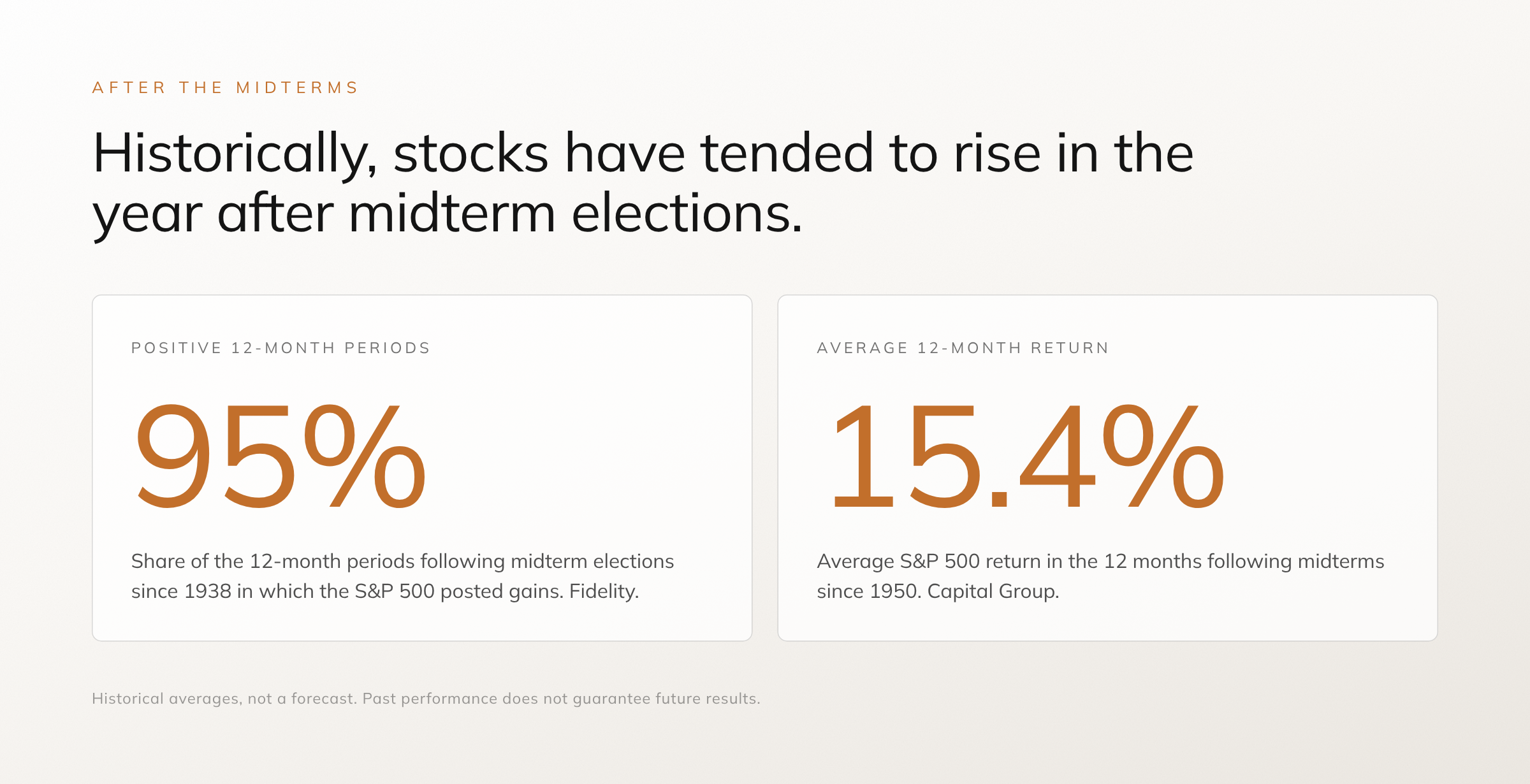
According to research published by Fidelity, the S&P 500 has posted gains in approximately 95% of the 12-month periods following midterm elections since 1938.
Capital Group's research shows that the average S&P 500 return during the 12 months following midterms since 1950 has been approximately 15.4%.
That's a substantial historical return.
Why does this happen?
One explanation is that markets dislike uncertainty. In the months leading up to elections, investors are trying to anticipate potential changes in taxes, spending, regulations, and economic policy.
Once the election is over, some of that uncertainty disappears.
Businesses and investors have a clearer picture of the political environment, allowing them to make decisions with more information.
However, those historical averages include very different economic environments. They don't mean stocks are guaranteed to rise after today's election.
Scenario One: Republicans Keep Both the House and Senate
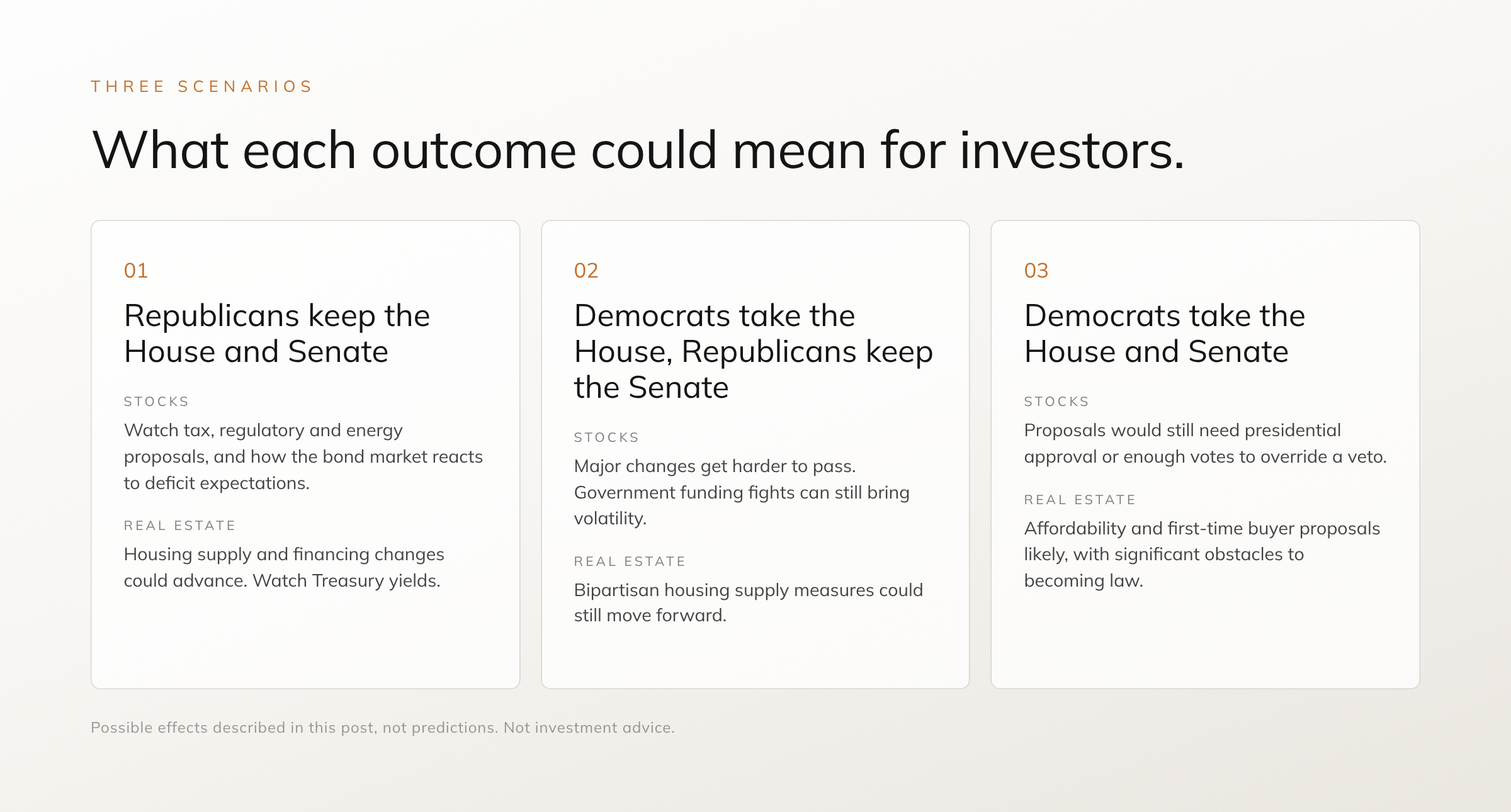
If Republicans maintain control of both chambers, President Trump would continue working with a Republican-controlled Congress.
That could provide additional opportunities to pursue the administration's existing economic priorities.
Areas investors would likely focus on include tax legislation, business deregulation, energy production, trade policy, and government spending.
What could happen to stocks?
Companies affected by tax and regulatory policy could respond to expectations about future legislation.
Energy producers, financial institutions, manufacturers, and other industries may see changes in investor expectations depending on which specific proposals move forward.
However, Republican control would not automatically guarantee rising stock prices.
One concern worth watching is the federal deficit.
If additional tax reductions or spending measures increase expected government borrowing without sufficient offsets, bond investors could demand higher yields.
Higher Treasury yields can increase borrowing costs throughout the economy.
What could happen to real estate?
Continued Republican control could allow the administration and Congress to pursue housing-supply initiatives, financing reforms, and regulatory changes.
Reducing certain development barriers could help builders increase supply over time.
However, lower regulatory costs don't automatically translate into lower home prices, especially when land, labor, materials, and financing remain expensive.
For real estate investors, the most important question may be whether fiscal policy puts additional upward pressure on Treasury yields.
Our Take: If Republicans keep both chambers, we would watch which tax and housing proposals actually advance, along with the bond market's reaction. The details of legislation will matter much more than the election headline itself.
Scenario Two: Republicans Lose the House but Keep the Senate
This would create a divided Congress, with Democrats controlling the House and Republicans controlling the Senate.
Major legislation would generally require more negotiation and bipartisan support.
The House would also gain the ability to pursue additional oversight and investigations of the administration.
What could happen to stocks?
Investors sometimes view divided government as a situation where major policy changes become more difficult.
That can create a more predictable legislative environment, although disagreements over federal spending and government funding can still generate volatility.
Morgan Stanley's October 2026 research found that, historically, the S&P 500 gained approximately 23% on average in the calendar year following midterms when a Republican president faced a Congress split between the parties.
That historical observation is interesting, but it comes from a limited number of election cycles and should not be interpreted as a forecast.
Markets could still experience significant volatility if inflation rises, earnings weaken, or the economy slows.
What could happen to real estate?
A divided Congress could make sweeping housing and tax legislation more difficult to pass.
Existing tax rules would generally remain in place unless changed through new legislation or affected by scheduled provisions.
Bipartisan housing measures could still move forward, particularly those addressing construction, permitting, or housing supply.
Mortgage rates, meanwhile, would continue responding primarily to inflation expectations, Treasury yields, and mortgage-market conditions.
Our Take: We would watch government funding negotiations and the bond market. Legislative gridlock doesn't automatically lower interest rates, and it doesn't eliminate economic uncertainty.
Scenario Three: Democrats Take Both the House and Senate
If Democrats gain control of both chambers, the country would have a Republican president and a Democratic-controlled Congress.
That would create a different political environment, with Congress having greater ability to pursue oversight and advance its own legislative priorities.
However, President Trump would retain veto authority, and Senate rules would continue limiting the passage of many types of legislation.
What could happen to stocks?
Some investors might initially reassess expectations around corporate taxation, regulation, energy policy, and government spending.
However, Democratic control of Congress would not automatically mean major tax increases or regulatory changes could become law.
Many proposals would still require presidential approval or sufficient congressional support to overcome a veto.
Historically, stocks have performed positively under a variety of combinations of presidential and congressional control.
Morgan Stanley's October analysis reported average S&P 500 gains of approximately 16% in the calendar year following midterms when a Republican president faced Democratic control of both chambers.
Again, those are historical observations, not guarantees.
What could happen to real estate?
Democratic congressional leaders could prioritize housing affordability, assistance for first-time buyers, rental housing, and other housing-related initiatives.
But legislation would face significant obstacles without agreement from the White House.
For investors, it's important to separate proposals from policies that actually become law.
A housing subsidy could increase purchasing power for eligible buyers, but its effect on home prices would depend partly on how quickly housing supply responds.
Likewise, additional housing construction incentives could increase supply over time, but development takes years.
Our Take: The important question would be which economic and housing policies receive enough bipartisan support to become law. Congressional control alone doesn't determine where property values or mortgage rates will go.
What About Real Estate? Does the Market Perform Better Under One Party?
This is an area where we think investors need to be careful about drawing conclusions.
Unlike stocks, residential real estate doesn't have a simple, consistent post-midterm performance pattern that can reliably tell us what home prices will do based on which party wins Congress.
Housing is influenced by several factors that can outweigh election results:
Mortgage rates and buyer affordability
Local housing inventory
Employment and wage growth
Population and migration trends
Construction costs and new housing supply
Rental demand and investment financing
A national election may influence housing policy, but it doesn't change the supply and demand conditions of every local market overnight.
Here in the Treasure Valley, a home in Meridian, a rental in Nampa, and a new construction property in Kuna may all respond differently to changing economic conditions.
That's why we believe local market knowledge remains extremely important.
Mortgage Rates: The Number Real Estate Investors Should Watch
One of the biggest factors affecting real estate right now continues to be the cost of borrowing.
According to Freddie Mac, the average 30-year fixed mortgage rate declined to 7.24% on October 29, compared with 7.32% the previous week.
That's an improvement, but financing remains expensive compared with recent years.
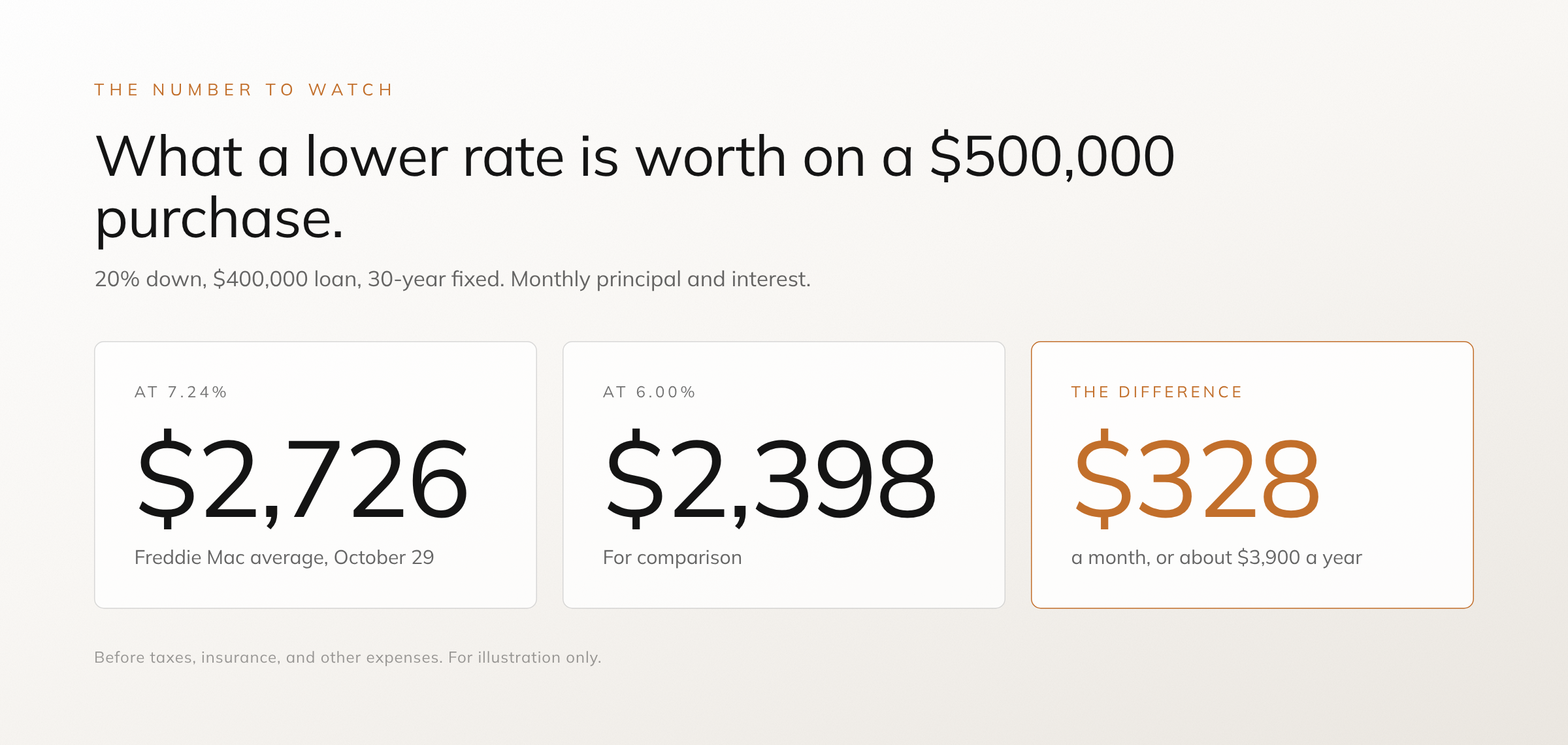
Consider a buyer purchasing a $500,000 property with 20% down.
That leaves a $400,000 mortgage.
At a 7.24% interest rate, the monthly principal and interest payment would be approximately $2,726.
At 6%, that payment would be approximately $2,398.
That's a difference of roughly $328 per month, or nearly $3,900 annually, before taxes, insurance, and other expenses.
For investors purchasing multiple properties, those differences can significantly affect cash flow and purchasing decisions.
Will the election lower mortgage rates?
Not necessarily.
Mortgage rates are influenced heavily by longer-term Treasury yields and the mortgage-backed securities market.
If investors become concerned about inflation or additional government borrowing, Treasury yields could rise.
If economic growth weakens or investors seek safer assets, yields could decline.
Both situations are possible regardless of which party controls Congress.
Our Take: We would pay more attention to the 10-year Treasury yield after the election than to the initial stock market reaction. That may provide a more useful indication of where mortgage financing could be headed.
Don't Forget About Japan and the Global Bond Market
While the U.S. elections will dominate headlines this week, we're continuing to watch developments in Japan.
The Bank of Japan's monetary policy, Japanese government bond yields, and the value of the yen remain important factors in global financial markets.
For years, investors used low-cost Japanese borrowing to finance investments elsewhere, including U.S. financial assets.
As Japanese interest rates have risen, that strategy has become more complicated.
A rapid strengthening of the yen could pressure investors who borrowed in Japanese currency, potentially causing them to reduce leveraged positions.
This is the carry-trade unwind risk we've discussed in previous updates.
Why does it matter this week?
Because changes in U.S. political expectations, Treasury yields, and the dollar could interact with Japanese currency and bond markets.
If Japanese investors change their demand for U.S. securities, that could influence American borrowing costs.
However, a disorderly global carry-trade unwind should not be assumed simply because the yen strengthens or Japanese yields rise.
Our Take: Even with the election taking center stage, we believe investors should continue watching Japan and the global bond market. Financial risks don't stop at our borders.
What We're Watching After Election
There are several things we'll be paying close attention to as election results come in and financial markets begin reacting.
First, the stock market's reaction. We'll be looking at whether any initial rally or decline continues beyond the first few trading sessions. Election-night moves can reverse as investors evaluate the details.
Second, the 10-year Treasury yield. This may tell us more about changing inflation and fiscal expectations than the stock market alone.
Third, mortgage rates. Any sustained movement in Treasury yields could eventually affect buyer affordability and real estate activity.
Fourth, housing policy. We'll be watching for specific proposals involving construction, financing, tax treatment, and investment properties.
Finally, global markets. Japan, oil prices, and international capital flows could remain important drivers of volatility regardless of the election outcome.
Our Investor Outlook: Don't Let Politics Replace Investment Fundamentals
One thing we've learned over the years is that it's easy to let political headlines influence financial decisions.
But the historical evidence shows that markets have performed well under different combinations of Republican and Democratic leadership.
That doesn't mean government policy doesn't matter. It absolutely does.
Taxes, regulations, spending, and housing legislation can all affect investments.
However, we believe investors should avoid making major decisions based solely on which party wins an election.
For stock investors, corporate earnings, valuations, economic growth, and interest rates will remain critical.
For real estate investors, purchase price, financing terms, rental income, property expenses, and local market conditions will continue to determine whether an investment makes sense.
There may be opportunities following the election as uncertainty fades and markets adjust to the results.
But rather than trying to predict which political outcome will produce the biggest market rally, we believe investors are better served by understanding how each possible outcome could affect their investments.
If you have any questions about the real estate market or investment opportunities, we're always happy to help.